EVΛƎ ARMOR / Pre-Execution Decision Architecture
Before AI Executes, Governance Must Be Designed.
EVΛƎ ARMOR is an AI governance implementation program that translates policies, rules and human authority into an operational decision structure before AI-assisted decisions move into action.
Designed for organizations deploying generative AI, AI agents and AI-assisted operational workflows.
No technical specification or completed AI system is required. We can begin with one planned or existing AI-assisted workflow.
Who It Is For
For organizations moving from AI experimentation to operational use.
EVΛƎ ARMOR supports cross-functional AI governance involving technical, operational, legal, risk and business decision-makers.
IT and Operations
Information systems, DevOps and operational teams responsible for system changes, automated actions and production environments.Risk and Compliance
Legal, compliance, risk management and internal audit teams responsible for rules, accountability and defensible decision processes.AI Product Owners
Product managers and service owners deciding what AI may recommend, approve, publish, modify, send or execute.Business Owners
Executives and operational owners accountable for customer impact, exceptions, escalation and final organizational responsibility.Technical Partners
AI vendors, system integrators and implementation partners seeking a governance layer around existing AI solutions.EVΛƎ ARMOR is designed for cross-functional implementation,
not for technical departments alone.
Enterprise AI Challenge
The hardest part of AI adoption is not always the model.
Organizations can introduce powerful AI systems and still remain uncertain about who may approve an action, which rule takes priority, when automated execution must stop and who ultimately accepts responsibility.
01
Rules conflict
AI may face several valid rules at once. Without a defined hierarchy, it can produce a plausible answer without the authority to act on it. A plausible answer is not the same as an authorized decision.02
Approval becomes symbolic
Human approval is ineffective when the approver lacks context, authority, rejection power or a clearly defined responsibility boundary.03
Stop conditions remain undefined
Policies may call for caution, but operational teams still need concrete conditions for HOLD, ESCALATE and STOP.04
Responsibility becomes unclear
When AI-supported decisions move quickly, responsibility can become fragmented across models, operators, managers and system owners.05
Policies remain disconnected
AI principles and internal policies do not automatically become executable decision rules inside real operational workflows.06
PoCs fail to reach production
A technical demonstration may work, yet deployment stalls because authority, escalation and accountability have not been designed.If any of these conditions apply, the missing component may not be
another AI model. It may be a Pre-Execution Decision Architecture.
From Policy to Operation
“A human makes the final decision” is not a complete governance design.
Policy establishes what an organization should protect. Operations require a more precise design for who decides, when intervention occurs, what evidence is available and what authority the person actually holds.
What policies typically state
✓
Important decisions require human review.
✓
AI should stop when material risk is detected.
✓
Applicable laws and internal policies must be respected.
✓
Appropriate authorization should be obtained.
What operations must define
✓
What qualifies as an important or high-risk decision?
✓
Who has approval, rejection or exception authority?
✓
Which rule takes priority when requirements conflict?
✓
What conditions trigger HOLD, ESCALATE or STOP?
✓
How is the reason for a decision preserved?
A New Governance Category
Pre-Execution Decision Architecture
EVΛƎ ARMOR does not only evaluate AI behaviour. It designs the conditions under which AI-supported action may proceed.
The missing operational layer
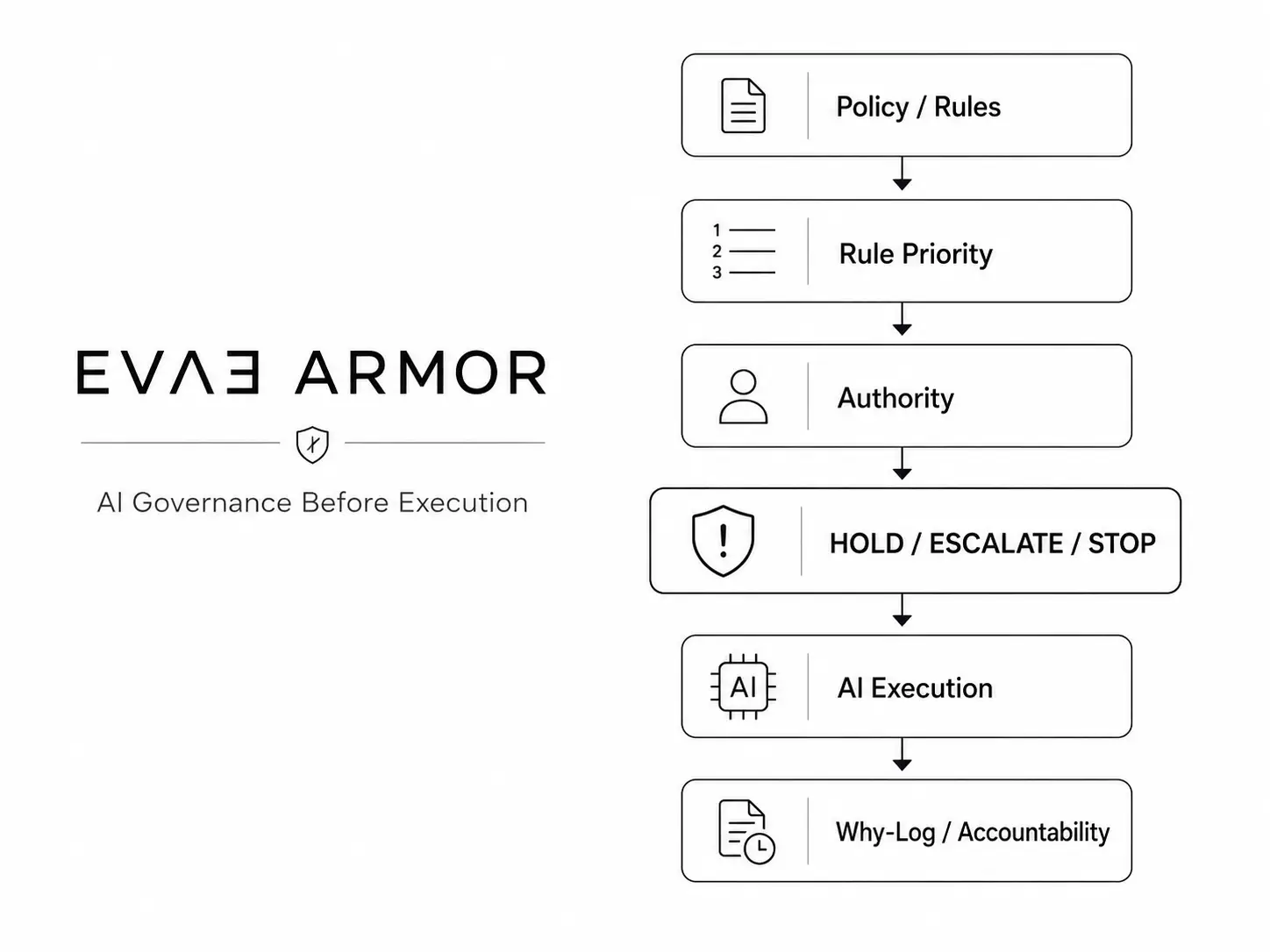
Policies do not interpret themselves. Between policy and execution, organizations need a traceable network of rule priority, decision authority, exception handling, stopping conditions and feedback.What EVΛƎ ARMOR connects
EVΛƎ ARMOR connects policy, interpretation, decision authority, execution, transparent records and organizational learning.EVΛƎ ARMOR is a Pre-Execution Decision Architecture implementation program.
Decision Example
When several valid rules conflict.
A simple refund request shows why AI performance alone cannot determine whether an action is authorized.
RULE A
Refund window
Refunds are permitted within 30 days of purchase.RULE B
Discount restriction
Discounted products are non-refundable.RULE C
Customer-protection exception
Claims involving misleading product descriptions require human review.SITUATION
A discounted product is returned after ten days.
Without a defined decision architecture
An AI system may select one rule, generate a convincing explanation and approve or reject the request without sufficient authority.With EVΛƎ ARMOR
1
Detect the rule conflict.
2
Identify the customer-protection exception.
3
Prevent automatic rejection.
4
Collect the information required for review.
5
Escalate the case to an authorized decision-maker.
6
Record the final decision and rationale in the Why-Log.
EVΛƎ ARMOR does not ask AI to choose the most convincing answer.
It defines who may decide, under what authority and on what evidence.
Why EVΛƎ
Why is Pre-Execution Decision Architecture still uncommon?
Existing AI governance already includes valuable policies, risk assessments, monitoring, security controls and audit mechanisms. The gap is that these functions are frequently managed separately, while the decision immediately before execution remains fragmented.
Principles and guidelines
They define what should be protected, but do not automatically determine the decision sequence inside a specific workflow.Monitoring and audit
They reveal model behaviour and outcomes, but are often separated from authority and stop conditions before execution.Human oversight
A human presence alone is insufficient without information, decision authority, rejection power and a defined responsibility scope.EVΛƎ ARMOR brings rule priority, authority, stopping,
exceptions, accountability and traceability into one
pre-execution decision structure.
Before and After Execution
Do not wait until after execution to explain responsibility.
Traditional governance often reviews AI output after it has already influenced a decision or action. EVΛƎ ARMOR moves rule priority, authority and stop conditions into the process before execution.
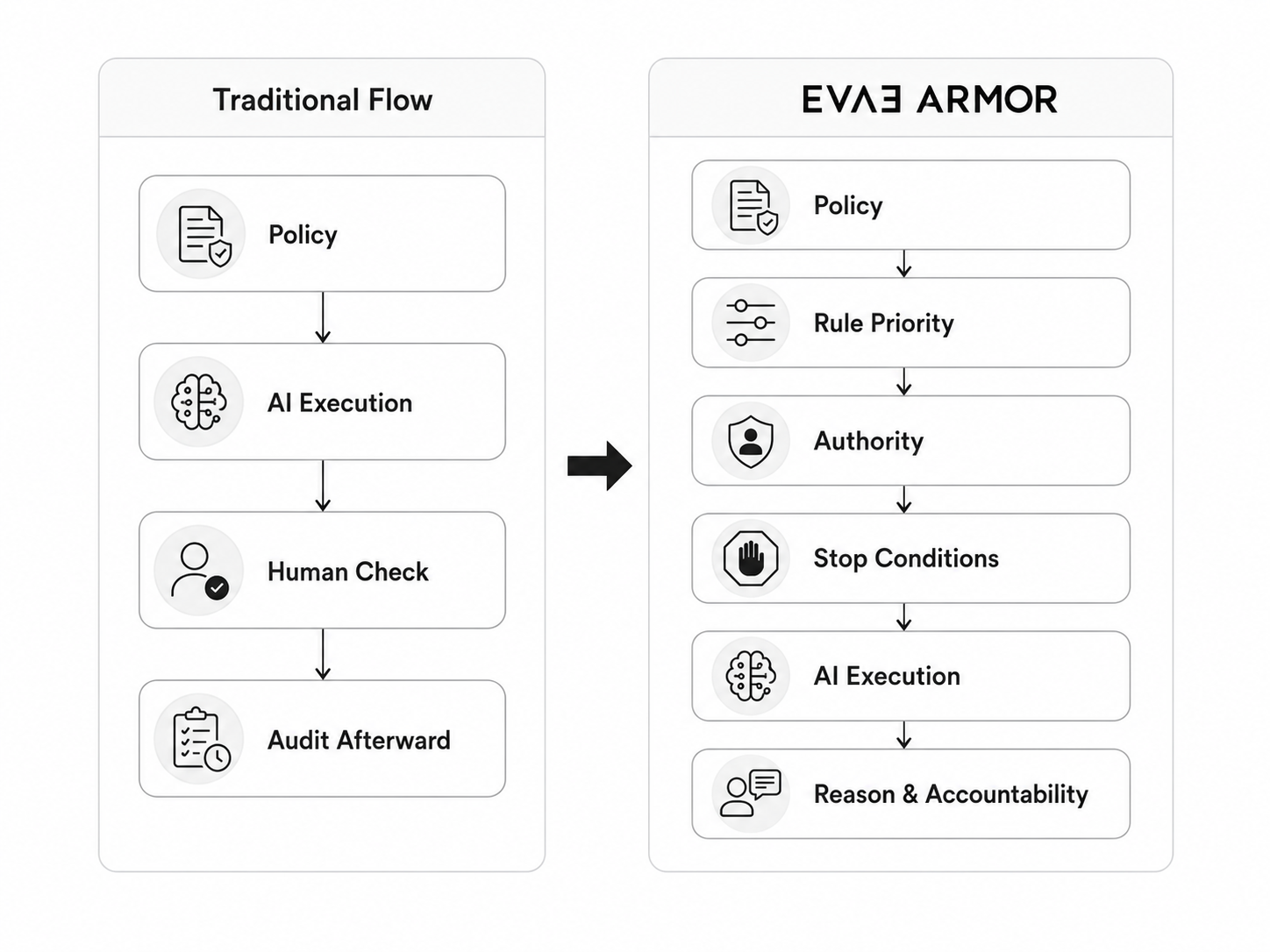
This is the foundation of EVΛƎ’s
Design-by-Transparency approach:
traceability is designed into the decision process,
not added afterward.
EVΛƎ Decision Structure
Four questions before AI-supported execution.
EVΛƎ structures decision-making through intent, possibilities, judgment boundaries and observation. The outcome is then returned to the next decision cycle rather than treated as an isolated event.
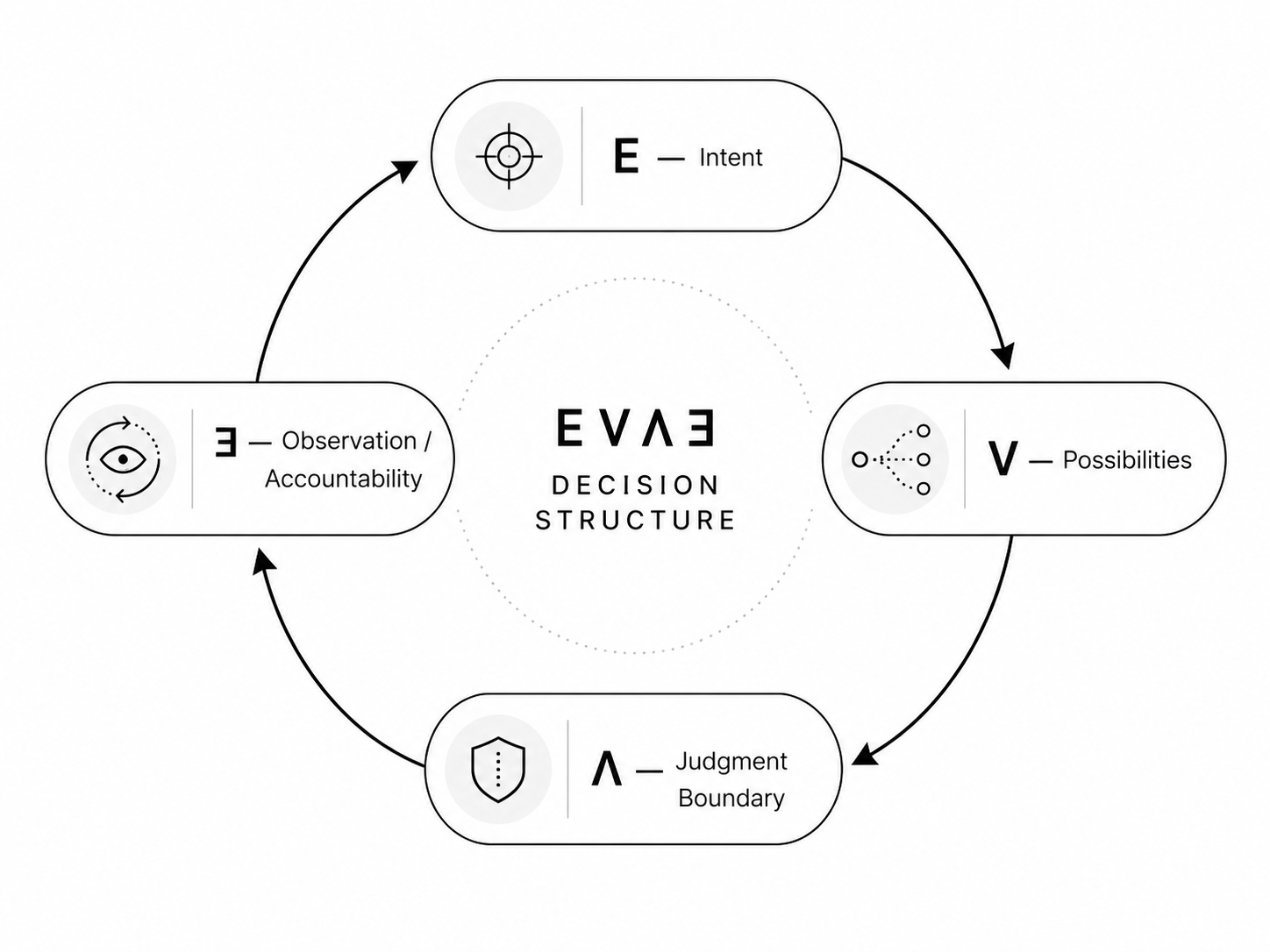
Intent
What is being attempted, for whom and for what purpose?Possibilities
What outcomes, alternatives, risks and exceptions may arise?Judgment Boundary
What may proceed, what requires approval and what must stop?Observation
What happened, why did it happen and what should change next?Enterprise Governance Application
The EVΛƎ core remains stable. Its enterprise layer makes it operational.
From E to V
Policy intent, policy trees, rule hierarchy and interpretation shape the options that may be considered.From V to Λ
AI or human decision input is evaluated against authority, evidence, exceptions, approval requirements and stop conditions.From Λ to Ǝ
Only an authorized action proceeds. The decision, evidence, authority and rationale are preserved as transparent records.From Ǝ back to E
Human conclusions and organizational learning update policies, rule priorities, exception handling and the next decision cycle.Transparent records are not only retained for audit.
They allow the organization to improve rule priorities,
stop conditions and future decisions.
Governance becomes a learning structure, not a static control document.
Operational Transformation
Turn AI policy into an executable decision structure.
Before EVΛƎ ARMOR
After EVΛƎ ARMOR
AI produces a plausible recommendation.
Permitted execution conditions are defined.
An approver exists, but authority is unclear.
Approval, rejection and exception authority are mapped.
AI should stop when risk appears.
Concrete HOLD, ESCALATE and STOP conditions are set.
Teams improvise when rules conflict.
Rule priority and escalation paths are designed.
Reasons remain in chats or individual memory.
Decisions and rationale are preserved in the Why-Log.
A PoC works but production deployment stalls.
Responsibility and authority are designed for deployment.
AI Governance Implementation Program
Begin with one AI-assisted decision flow.
The program does not begin by redesigning the entire organization. It begins with one practical use case and turns governance principles into operational decision conditions.
STEP 00
Initial Use-Case Discussion
✓
Identify one existing or planned AI-assisted workflow.
✓
Clarify what the AI proposes, decides or executes.
✓
Identify the current human approver and accountable owner.
✓
Review known exceptions, conflicts and operational concerns.
✓
Identify conditions requiring human review or stopping.
✓
Select a potential scope for Governance Discovery or a PoC.
PHASE 01
Governance Discovery
✓
Review the current AI use case and operational workflow.
✓
Identify decisions influenced by AI output.
✓
Map applicable policies and conflicting requirements.
✓
Clarify approval, rejection and exception authority.
✓
Define HOLD, ESCALATE and STOP conditions.
✓
Propose accountability and decision-trace requirements.
PHASE 02
Implementation PoC
✓
Translate governance requirements into a decision flow.
✓
Design Why-Log and pre-execution trace requirements.
✓
Apply the structure to a prototype or demonstration.
✓
Test normal, exceptional and conflicting-rule scenarios.
✓
Review consistency, escalation and operational usability.
✓
Prepare an implementation and expansion roadmap.
Deliverables
Governance is delivered as an operational structure.
The engagement is designed to produce practical governance artifacts, not only discussion or general recommendations.
Analysis and visualisation
✓AI use-case assessment
✓Current workflow map
✓AI decision-flow diagram
✓Risk and exception inventory
Authority and stopping
✓Rule-priority proposal
✓Human approval points
✓AI stop-condition list
✓Execution-authority map
Accountability and implementation
✓Escalation flow
✓Responsibility map
✓Why-Log design
✓Implementation roadmap
These deliverables can support internal AI policy implementation,
system requirements, approval-flow design, discussions with AI vendors,
audit and explanation materials, and production-deployment decisions.
Use Cases
Where AI output may influence real action.
EVΛƎ ARMOR can be applied wherever AI-assisted output affects operational execution, customer communication, institutional decisions or organizational responsibility.
Customer Service and Refunds
Govern refund decisions, policy exceptions and customer-protection requirements before an automated response is issued.Typical issue
Refund-window rules, discount restrictions and
misleading-description claims may conflict.
EVΛƎ role
Define rule priority, human escalation and stop conditions
before response execution.
Expected value
More consistent, traceable and accountable customer handling.
IT Operations and DevOps
Govern AI-assisted system changes, incident response and automated operational actions before they affect production environments.Typical issue
AI recommends a system-level action without sufficient
risk boundaries or authority clarity.
EVΛƎ role
Separate routine execution from high-risk changes requiring
approval, delay or rollback readiness.
Expected value
Reduced operational risk and stronger accountability
before system-level action.
AI Agents
Define what an AI agent may send, purchase, publish, modify or delete without additional authorization.Typical issue
The agent has technical capability but no clearly designed
operational authority.
EVΛƎ role
Establish execution boundaries, approval thresholds,
escalation paths and prohibited actions.
Expected value
Greater control over autonomous action without removing
the benefit of automation.
Current Engagement Opportunities
Initial PoCs and collaborative validation partners are now being considered.
EVΛƎ ARMOR is currently open to initial PoCs and collaborative validation with organizations, technical partners, governance specialists and research institutions.
Small-scale PoCs
Begin with one operational workflow rather than an organization-wide deployment.Existing AI systems
Evaluate how a pre-execution governance layer can surround an existing model, agent or AI-assisted workflow.International validation
Collaborate across different organizational, technical and regulatory environments.Specialist collaboration
Work with legal, compliance, technical, risk and governance specialists on practical implementation conditions.Early partners can help validate how Pre-Execution Decision Architecture
should operate across real organizational environments.
Scope
EVΛƎ ARMOR is not an AI model development service.
The focus is the governance structure surrounding existing AI systems, rather than development or retraining of the underlying model.
What EVΛƎ ARMOR provides
✓
Operational decision architecture for existing AI
✓
Rule-priority and authority design
✓
Approval, stopping and exception conditions
✓
Decision reasoning and accountability traces
What is outside the core scope
–
Foundation-model or LLM development
–
Legal advice or replacement of qualified legal review
–
Standalone cybersecurity assessment
–
Software development without a governance objective
Background and Credibility
Designed as an operational structure, not only as a governance concept.
EVΛƎ ARMOR is being developed through continued engagement with international AI governance discussions, public-policy processes, operational demonstrations and intellectual-property development.
INTERNATIONAL POLICY AND GOVERNANCE
EU AI governance engagement
✓
Participation in EU AI Office-related stakeholder workshops
and consultation-related discussions
✓
Contribution to discussions on operational AI governance
and Design-by-Transparency
✓
Engagement as an international stakeholder from Japan
EU TRANSPARENCY REGISTER
Registered organization
✓
Registered organization: Amuletplus G.K.
✓
EU Transparency Register
✓
Registration number:
1702237103721-40
FRAMEWORK AND INTELLECTUAL PROPERTY
Independent governance framework
✓
EVΛƎ Dual-Loop Governance Framework
✓
Design-by-Transparency
✓
Pre-execution AI governance
✓
Related patent application filed in Japan
IMPLEMENTATION AND PUBLIC RESOURCES
Operational development
✓
EVΛƎ White Paper published
✓
Reference demonstrations for finance,
healthcare and IT operations
✓
EVΛƎ ARMOR implementation program
✓
Model-independent external decision architecture
FAQ
Frequently Asked Questions
Is EVΛƎ ARMOR an AI model development service?
No. EVΛƎ ARMOR designs the rules, authority,
approval conditions, stopping conditions,
accountability and decision traces surrounding
existing AI systems.
Can we begin before deploying AI?
Yes. Governance can be designed before deployment
by defining the intended use case, operational authority,
prohibited actions and human intervention points.
Can EVΛƎ ARMOR work with an existing AI policy?
Yes. Existing policies can be translated into more concrete
operational decision rules, approval points,
stopping conditions and escalation flows.
Does EVΛƎ ARMOR guarantee legal or regulatory compliance?
No. EVΛƎ ARMOR does not replace qualified legal advice.
Where appropriate, the governance design can be developed
in coordination with legal, compliance, security
and technical specialists.
Can a smaller organization use the program?
Yes. The initial engagement can focus on one workflow
or one AI-assisted decision rather than an
organization-wide implementation.
Can Amuletplus participate in an international PoC?
Yes. Amuletplus is open to joint PoCs with international
companies, technical partners, consultants
and research organizations.
How is pricing determined?
Pricing depends on the target workflow, existing systems,
participating departments, PoC scope, duration and deliverables.
After the initial discussion, Amuletplus can propose the scope,
schedule, outputs and cost.
What materials are required for the first discussion?
No mandatory documents are required. We can begin with any available
information about the workflow, intended AI use, current approval process,
internal policy and difficult decision scenarios.
What We Discuss First
You do not need a completed AI system or technical specification.
Begin with one current or planned AI-assisted workflow. We will use that workflow to identify the first governance questions.
✓
The business process where AI is used or planned
✓
What the AI proposes, decides, sends or executes
✓
The current approver and accountable owner
✓
Known exceptions or conflicting rules
✓
Conditions where AI should stop or return to a human
✓
One workflow that may be suitable for a PoC
Governance can be designed before the AI system is completed.
Start with One Use Case
Where should AI stop, and where must human responsibility begin?
Share one AI-assisted workflow or operational challenge. We can begin by identifying the rules, authority, intervention conditions and accountability structure required before execution.Technical specifications are not required for the first discussion.